
Finance Process Automation: The Complete UK Business Guide
Finance process automation is rapidly becoming one of the most important investments for organisations across the United Kingdom. As businesses face increasing pressure to improve efficiency, reduce costs, and maintain compliance, manual financial processes are no longer sustainable.
From invoice approvals and expense management to financial reporting and forecasting, finance teams are expected to deliver faster results with greater accuracy. Traditional methods that rely heavily on spreadsheets, emails, and manual data entry often create bottlenecks that slow business growth.
Today’s finance leaders are embracing automation technologies to eliminate repetitive tasks and allow employees to focus on strategic decision-making. Companies that implement finance process automation successfully often experience significant productivity improvements, stronger compliance, and better financial visibility.
Whether you run a small business, a growing enterprise, or a multinational corporation, understanding finance process automation can help you gain a competitive advantage in an increasingly digital economy
Definition of Finance Process Automation

Finance process automation involves the use of technology, software applications, and smart processes in order to carry out financial processes with minimal human interference.
Whereas, in traditional accounting, people have to key in information, approve transactions, reconcile accounts, and create reports manually, finance process automation automates all these operations.
Components of Finance Automation
Almost all systems for finance automation consist of the following:
Data entry
Work flow
Invoicing
Expenses
Accounts Payables Automation
Accounts Receivables Automation
Financial Reporting
Compliance
Audit Trail
Forecasting & Analytics
It is crucial to note that the ultimate aim of using such systems is to simplify finance processes.
Finance Process Automation – The Importance Is Growing Every Day
The world of finances has seen dramatic changes over the last ten years. Companies should now cope with:
More regulations
Higher number of transactions
Remote work conditions
Higher costs
Real-time reporting needs
Cybersecurity issues
Finance process automation will help companies cope with all these challenges successfully.
Working of Finance Process Automation
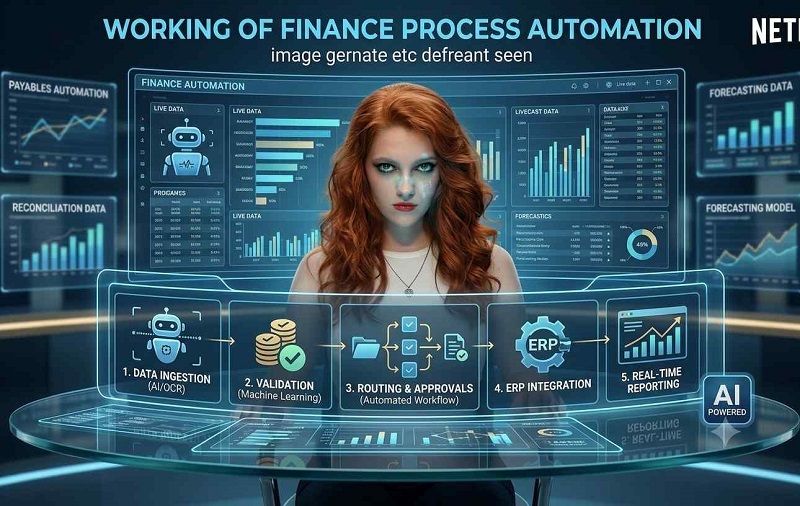
Knowing how automation works will enable companies to understand areas for improvements.
Step 1: Collecting Data
Software used for automation will collect data from:
Invoice
Receipts
ERP Systems
Banks
Payroll Software
CRM Systems
Sophisticated technology like Optical Character Recognition (OCR) can collect the data automatically.
Step 2: Data Validation and Verification
The system compares data based on defined parameters.
This involves:
Deduplication of invoices
Tax checking
Verification of suppliers
Purchase order verification
Step 3: Workflow Execution
After data validation, transactions are processed via approval workflow systems.
Approval emails are sent out and tasks are completed online.
Step 4: Recordation and Reconciliation
Authorized transactions are recorded directly to accounting software.
After that, reconciliation is done, and any discrepancies are found by the software.
Step 5: Reporting and Analysis
Immediate reports are created and presented to management.
Major Areas in Finance Process Automation
Automation of Accounts Payable Processes
The accounts payable process is frequently one of the earliest to be automated.
The traditional accounts payable process involves:
Receipt of invoices
Data input
Approval process
Payment processing
Document archiving
Automation ensures that invoices are automatically processed without any manual intervention.
Advantages of AP Automation
Quick invoicing
Less penalty charges
Better relations with suppliers
Cost-effective administration
Visibility improvement
Accounts Receivable Automation
Cash flow is important for all businesses.
Accounts receivable automation allows firms to:
Invoices creation
Payment notifications
Collections management
Account management
Payments processing
This helps decrease the balance due.
Expenses Management Automation
Expenses can be filed by employees online via mobile applications.
Expenses management automation helps in validating claims, checking policy adherence, and processing reimbursements.
Automated Financial Reporting
Creating reports manually on a monthly basis requires substantial effort.
With automated financial reporting, it is possible to have:
Reporting in real-time
Creating dashboards
Tracking KPIs
Regulatory reporting
Management reporting
This will allow finance departments to spend their time analyzing data.
A Step-by-Step Approach to Finance Process Automation

Step 1: Evaluate Current Procedures
Begin by mapping out existing processes.
Determine:
Processes that are manual
Processes that have bottlenecks
Processes that are prone to errors
Processes that have compliance issues
Step 2: Identify Areas with High Impact
Choose processes that have:
High volume transactions
Many manual steps involved
Errors
Compliance needs
Accounts payable should be your first step.
Step 3: Set Objectives
Set achievable objectives that may include:
50% reduction in processing time
Accurate billing
Cost savings
Faster reporting
Step 4: Select Suitable Technology
Consider technology in terms of:
Scalability
Integration options
Security features
Usability
Vendor support
Step 5: Standardising Workflow
Processes work optimally where they are clear and standardised.
Approval procedures should be established prior to implementation.
Step 6: Training Employees
Implementation success is determined by user adoption.
Training programs include:
Workshops
Guides
Support
Change management
Technologies Driving Financial Automation
Artificial Intelligence (AI)
AI assists in enabling systems to learn and make better decisions through time.
Includes:
Detection of frauds
Forecasting
Risk assessment
Classification of data
Machine Learning
Machine learning allows systems to become increasingly efficient as the number of transactions rises.
Robotic Process Automation (RPA)
What Is It?
RPA simulates human activity in software applications.
RPA is most useful in performing repetitive jobs.
Optical Character Recognition (OCR)
What Is It?
OCR enables hard copy documents to be digitized.
This makes the need for manual input negligible.
Cloud Computing
What Is Cloud Computing?
Common Obstacles in Automation Projects
While automation brings many advantages, companies frequently face challenges.
Change Resistance
Employees might fear for their positions.
Effective communication and training are crucial.
Low Data Quality
Data accuracy is vital in automation.
Data must be cleaned up and standardized before any automation is applied.
Integration Problems
Older systems might cause problems.
Proper planning will help reduce difficulties.
Lack of Clear Goals
Without quantifiable objectives, it’s difficult to measure success.
Remember to set key performance indicators (KPIs) first.
Higher-level Finance Automation Methods
Companies looking for more competitive advantages can adopt higher-level features.
Predictive Financial Forecasting
AI-based prediction systems detect patterns and forecast future events.
Continuous Accounting
Instead of closing cycles every month, companies keep updated financial statements at all times.
Intelligent Cash Flow Management
Automation detects patterns in payments and manages working capital.
Automated Risk Monitoring
High-tech systems detect suspicious activities by monitoring transactions in real-time fashion.
Self-service Financial Analysis
Decision-makers have access to financial insights without requiring help from finance specialists to generate reports.
Also asked by people
Conclusion
Financing process automation is not something only large corporations can afford anymore; it is now a necessity for all companies who wish to operate efficiently, effectively and profitably.
Through automation of their finances, organizations will save money by minimizing their expenditure on operational costs, be able to make decisions quickly and have their finance professionals dedicate time to other more productive tasks.
Businesses who will succeed in the future will be those who implement automation strategically. That is, the company will first automate its most impactful processes and work gradually from there.
With new advancements in artificial intelligence and machine learning, there will be even more chances for finance transformation in the future. Organizations that start investing in financing automation now will be better placed for the future.
So, what is left to do? Start analyzing your finance processes and identifying where you need help, then start automating.